Why Robots Can't Move Like Humans Do
An industry perspective on the coordination problem holding humanoid robotics back.
 Vince Truong, D.O.Founder, Neurobotics IP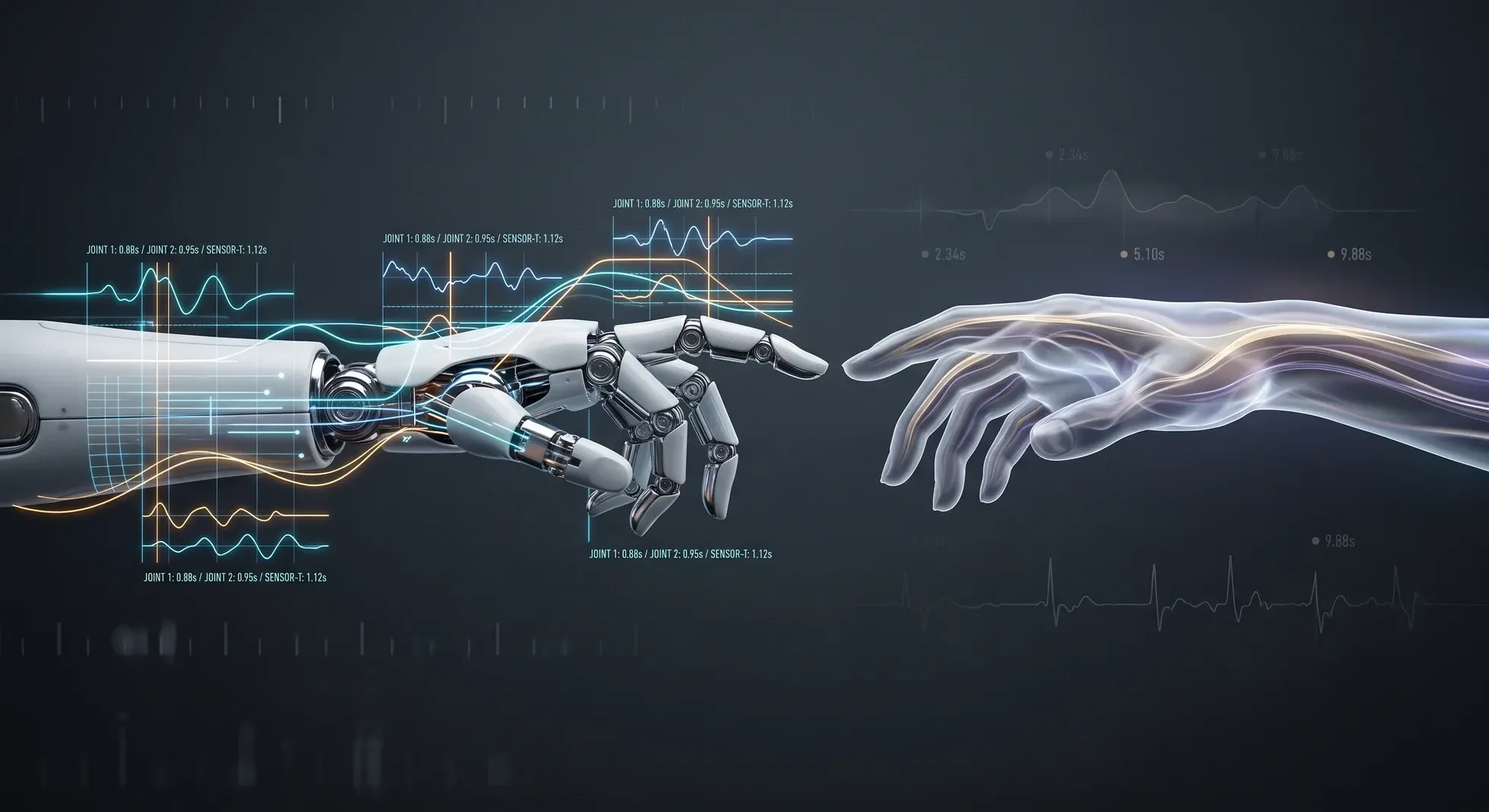
The Coherence Papers · Part I
For the first time in history, humanoid robots are leaving research laboratories and entering the real world. Demonstrations are increasingly impressive: robots walking unaided, manipulating objects, navigating unstructured environments, and operating alongside humans. The trajectory points toward meaningful deployment—in factories, warehouses, hospitals, and eventually homes.
Yet anyone who has watched these demonstrations closely has noticed something curious. A humanoid robot retrieves an object, walks back to the person who requested it, and then hesitates—somehow unable to release the object smoothly into the waiting hand. Another robot navigates a hallway with confidence until an unexpected variable disrupts its balance and it falls. A third manipulates a delicate object with remarkable precision until the lighting changes and the grasp fails.
These are not isolated mistakes, nor are they simply software bugs waiting to be patched. They are manifestations of a deeper architectural problem that remains unresolved across the robotics industry. As robots become more capable, the challenge is no longer generating intelligent behavior in isolation. The challenge is coordinating dozens of independent subsystems so that they behave as a single coherent organism.
The coordination problem
Human movement appears effortless because the nervous system continuously integrates vision, touch, proprioception, vestibular feedback, and motor commands into a unified perception of the body and environment. This integration occurs across billions of neurons operating in parallel. Although biological systems are far from perfectly synchronized, they possess powerful mechanisms for resolving timing uncertainty and maintaining coherent action in dynamic environments.
Humanoid robots face a similar challenge. To move naturally and reliably through the world, they must combine information from cameras, LiDAR, inertial measurement units, tactile sensors, force sensors, joint encoders, motor controllers, and increasingly complex AI systems. Each subsystem contributes a different piece of reality. The robot’s effectiveness depends on its ability to transform those fragments into a single, coherent understanding of itself and its surroundings.
This paper refers to that capability as coordination.
Coordination is the ability of a robotic system to maintain a consistent understanding of itself and its environment across sensing, computation, planning, and actuation subsystems in real time.
Coordination is a timing problem
At its core, coordination requires temporal coherence. Sensors, processors, planners, and actuators must agree not only on what is happening and where it is happening, but also when it is happening. When that agreement begins to break down—even by milliseconds during high-speed dynamic tasks—the robot’s internal model of reality starts to diverge from the physical world. Those errors propagate through perception, state estimation, planning, and control, degrading performance and sometimes causing outright failure.
The challenge extends beyond synchronization alone. Modern robots must simultaneously solve problems of perception uncertainty, state estimation, control stability, motion planning, and environmental adaptation. Yet all of these functions depend on a common foundation: the ability to coordinate information across multiple subsystems operating at different speeds and under different constraints. Without coordination, advances in artificial intelligence, sensing technology, and computing power cannot be fully realized.
Why existing tools fall short
Existing technologies such as IEEE 1588 Precision Time Protocol (PTP), EtherCAT, Synchronous Ethernet, and software synchronization frameworks provide important components of the solution. However, they were developed primarily to solve timing and communication problems within networks, industrial automation systems, and telecommunications infrastructure. Coordinating a humanoid robot requires something broader: maintaining temporal and informational coherence across perception, computation, planning, and actuation simultaneously while operating in an unpredictable physical environment.
The consequences extend beyond engineering elegance. Coordination limits determine how fast a robot can move, how safely it can operate around people, how much uncertainty it can tolerate, and ultimately whether it can create economic value in real-world environments. In many cases, coordination—not intelligence—becomes the factor that determines deployment readiness.
The real bottleneck
As the robotics industry advances, attention naturally focuses on more powerful processors, larger AI models, improved sensors, and increasingly sophisticated control algorithms. These developments are essential. The robots will get better, the models will grow more capable, and perception will become more accurate. Yet none of these advances removes the underlying challenge. A robot can only act on the reality it believes exists, and when its sensors, controllers, and decision systems disagree about that reality, performance inevitably suffers.
The question facing the industry is whether it recognizes that coordination—not computation alone—may be the bottleneck that ultimately determines how capable humanoid robots become.
I believe it is. And I believe coordination is not a problem to be patched in software after the fact, but one that can be solved at the foundation—deliberately, and once—so that the industry can build on a shared basis rather than reinventing it platform by platform. That is the work I have committed myself to, and the subject of what comes next.
Vince Truong, D.O., is an emergency medicine physician and independent inventor based in Maui, Hawaii. He is the founder of Neurobotics IP, an IP-licensing company whose patent portfolio addresses the coordination problem described in this paper.