Time: The Invisible Sensor
Time isn't a sensor, yet every sensor depends on it — why a shared sense of time is what turns independent measurements into a single perception.
 Vince Truong, D.O.Founder, Neurobotics IP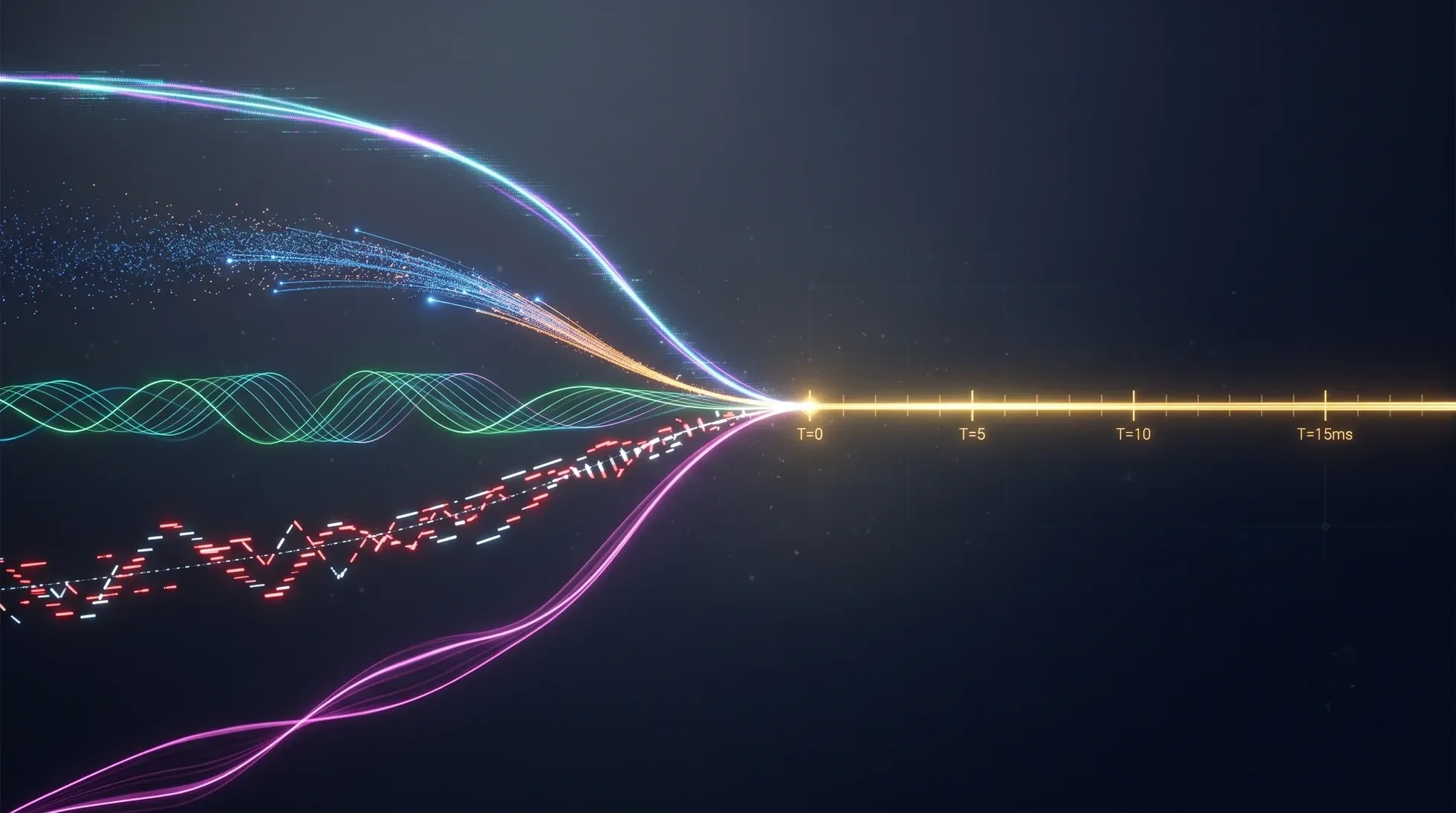
The Coherence Papers · Part II
In Part I, I argued that the next frontier in robotics may not be greater intelligence but greater coherence. That argument rests on a single, underappreciated idea: time.
Time isn’t a sensor. It measures no light, no sound, no force, no motion. And yet every sensor depends on it to give its readings meaning.
The orchestra problem
Picture a symphony orchestra. Every musician can play every note flawlessly, but if each section follows a slightly different beat, the result stops being music and becomes noise. Nothing is wrong with the instruments — what’s been lost is temporal alignment, and no amount of individual skill makes up for it.
Robotic systems face the same problem. A camera captures an image, a LiDAR scans the space, an inertial unit registers acceleration, joint encoders report movement, a microphone picks up sound. Each of these measurements can be perfectly accurate on its own. The hard question is whether they describe the same moment in the physical world.
As robots grow more distributed, that question only gets harder. Sensors run at different frequencies. Processors add variable delays. Networks introduce latency. Software schedules work asynchronously. Each component contributes just a sliver of timing uncertainty — but those slivers accumulate, and together they shape how faithfully a robot reconstructs reality.
Time as the common reference
Which points toward a shift in how we might think about time: not as metadata stapled to a measurement after the fact, but as the common reference that lets independent observations become a single, unified perception. Put another way — time doesn’t tell a robot what happened. It tells the robot whether two observations belong to the same event. In a fast-moving environment, that distinction is everything.
Consider a rover crossing uneven terrain. Its cameras flag an obstacle, its LiDAR measures the distance, its wheel encoders report motion, its inertial sensors catch a sudden change in pitch. Every subsystem is contributing real information — but the value of that information depends entirely on whether the pieces describe the same physical instant. The more confidently a system can align its observations in time, the more coherent its picture of the world becomes.
Intelligence is only as good as its inputs
None of this is an argument against artificial intelligence. AI remains indispensable for recognizing patterns, making decisions, and adapting to the unfamiliar. It’s an argument that intelligent reasoning is only ever as good as the inputs beneath it. Sharpen a system’s temporal coherence, and you sharpen the consistency of everything the intelligence reasons over.
Biology offers a striking point of comparison. Human perception emerges from billions of neurons firing across separate sensory pathways, and yet the brain fuses those signals into what we experience as a single, seamless present. Neuroscientists are still working out exactly how that integration happens; much of it remains genuinely unknown. But whatever the mechanism, the lesson holds — perception succeeds by weaving many streams of information into one coherent experience.
Future robots should reach for something similar: not by copying biology, but by taking up the engineering principle underneath it — distributed observations gain their value when they share a common sense of time.
If that’s right, then a timestamp is far more than bookkeeping. It’s the thread that binds individual measurements into a coherent understanding of the world.
In the next paper, I’ll look at how biological nervous systems achieve their remarkable coordination — and what robotics might learn from them without simply imitating what evolution built.