The Birds and the Bees (And Let Us Not Forget the Fish)
What flocking birds, schooling fish, and a beehive reveal about organization arising from many different parts in relationship to one another, not from sameness or a central controller.
 Vince Truong, D.O.Founder, Neurobotics IP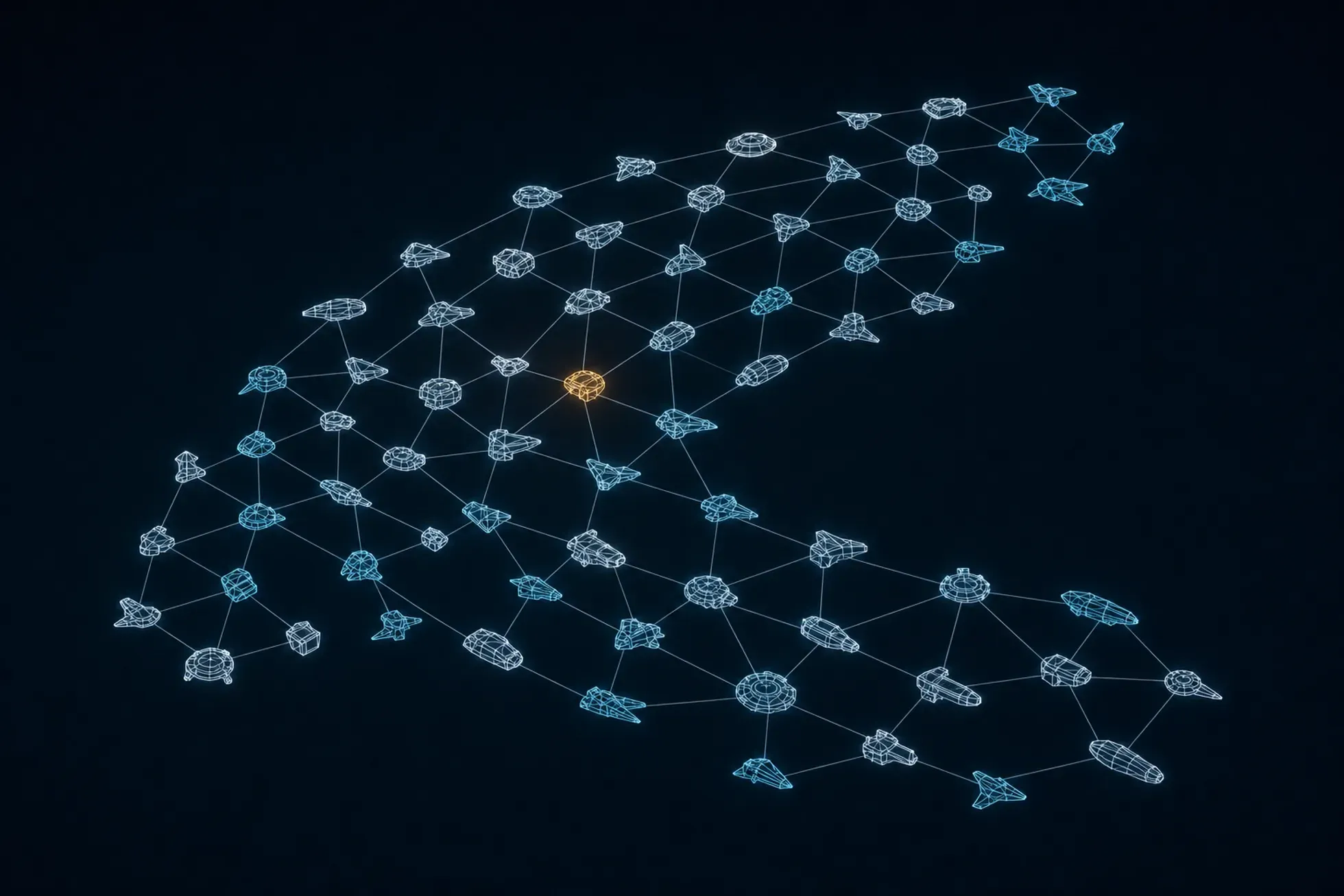
A Little Side Trip
Don’t worry.
This isn’t that conversation about the birds and the bees.
I have something much less awkward in mind.
I have been thinking about what happens when birds flock, fish school, and bees build a colony.
At first, these may seem like three examples of essentially the same thing: many individuals somehow behaving like a larger whole.
But look more closely, and they reveal something more interesting.
The Birds
Watch a large flock of birds moving across the sky.
Hundreds of birds may turn almost simultaneously.
They accelerate.
They spread apart.
They come together.
Sometimes the entire flock seems to change direction as though it were a single organism.
But it isn’t.
There is no bird flying above the others issuing commands.
No single bird carries a complete map showing the position and intended movement of every other bird.
Each bird sees only part of what is happening.
It responds to nearby birds, spacing, direction, changes in the environment, perhaps a threat.
And somehow, from all of those local interactions, organized movement appears.
A flock.
That raises a deceptively simple question:
Where does the organization come from?
Our instinct is often to look for a central controller.
Who is in charge?
Who has the complete picture?
Who tells everyone else what to do?
But nature often seems perfectly comfortable without one.
And Let Us Not Forget the Fish
Now look underwater.
A school of fish can perform the same kind of visual magic.
Hundreds or even thousands of individuals can move together, turn, separate, regroup, and respond to danger while preserving the organization of the school.
Again, no single fish needs to understand everything happening throughout the group.
Each occupies a different position.
Each receives somewhat different information.
Each makes its own adjustments.
Yet those differences can still fit together.
The fish remain individuals.
And the school remains a school.
That suggests something important:
Different does not mean disconnected.
Organization does not necessarily require every participant to possess the same information or perform exactly the same action at exactly the same moment.
But then the bees make the puzzle even more interesting.
The Bees
A beehive is not simply a collection of individuals moving together.
It is a collection of individuals doing different things.
Some bees forage.
Some care for developing young.
Some guard the entrance.
Others help regulate conditions within the hive or process resources.
Their roles differ because the needs of the colony differ.
And no single bee needs to understand everything happening throughout the hive for the hive to function.
This gives us something the flock and the school do not show quite as clearly.
Specialization.
The hive succeeds not despite its differences, but partly because of them.
Imagine what would happen if every bee decided to guard the entrance.
Who would forage?
Who would care for the young?
Or imagine every bird in a flock trying to occupy exactly the same position.
Or every fish in a school making exactly the same movement regardless of where it was relative to its neighbors.
Sameness would not necessarily improve the system.
It might destroy it.
Uniformity is not the same thing as organization.
That distinction matters.
Different Does Not Mean Disconnected
We often judge complex systems by examining their individual parts.
How fast can the bird fly?
How quickly can the fish respond?
How efficiently can the bee forage?
Those are useful questions.
But they do not completely explain the flock, the school, or the hive.
Something else becomes possible when the individuals interact.
The relationships matter.
A bird does not contain the flock’s formation.
A fish does not contain the school’s movement.
A bee does not contain the organization of the hive.
And yet the flock turns.
The school moves.
The hive survives.
Some of the capability of the larger system seems to arise not simply from what each individual can do, but from how their different actions relate to one another.
An Orchestra Makes This Easier to Hear
Perhaps a human example makes the distinction clearer.
Consider an orchestra.
The violin does not play the same notes as the cello.
The percussion section does something entirely different.
Some musicians may play rapidly while another holds a single note.
If we judged an orchestra by uniformity, it would look terribly disorganized.
Everyone is doing something different.
But those differences are structured.
Tempo relates one musician to another.
The score relates individual notes to the larger composition.
Each musician contributes something different while remaining connected to the same evolving piece of music.
If those relationships are preserved, difference creates richness.
If those relationships are lost, difference becomes noise.
The instruments haven’t changed.
Their capabilities haven’t changed.
The relationships have.
That may be the more interesting lesson hiding inside the birds, the fish, and the bees.
Nature does not seem to demand sameness.
It allows different information.
Different positions.
Different roles.
Different speeds.
Different scales.
And yet those differences can still participate in larger organized behavior.
The flock remains a flock.
The school remains a school.
The hive remains a hive.
Perhaps, then, the remarkable thing is not that many somehow become one.
They don’t.
They remain many.
The bird remains a bird.
The fish remains a fish.
The bee remains a bee.
What changes is what becomes possible through their relationships.
And that leaves me with a question:
What allows many different parts to remain one system as the world around them changes?
That is the question I want to explore next.