How Long Is a Nanosecond?
A nanosecond is easy to define and almost impossible to feel — so this side trip stretches the scale until human intuition can take in what machine-scale timing actually spans.
 Vince Truong, D.O.Founder, Neurobotics IP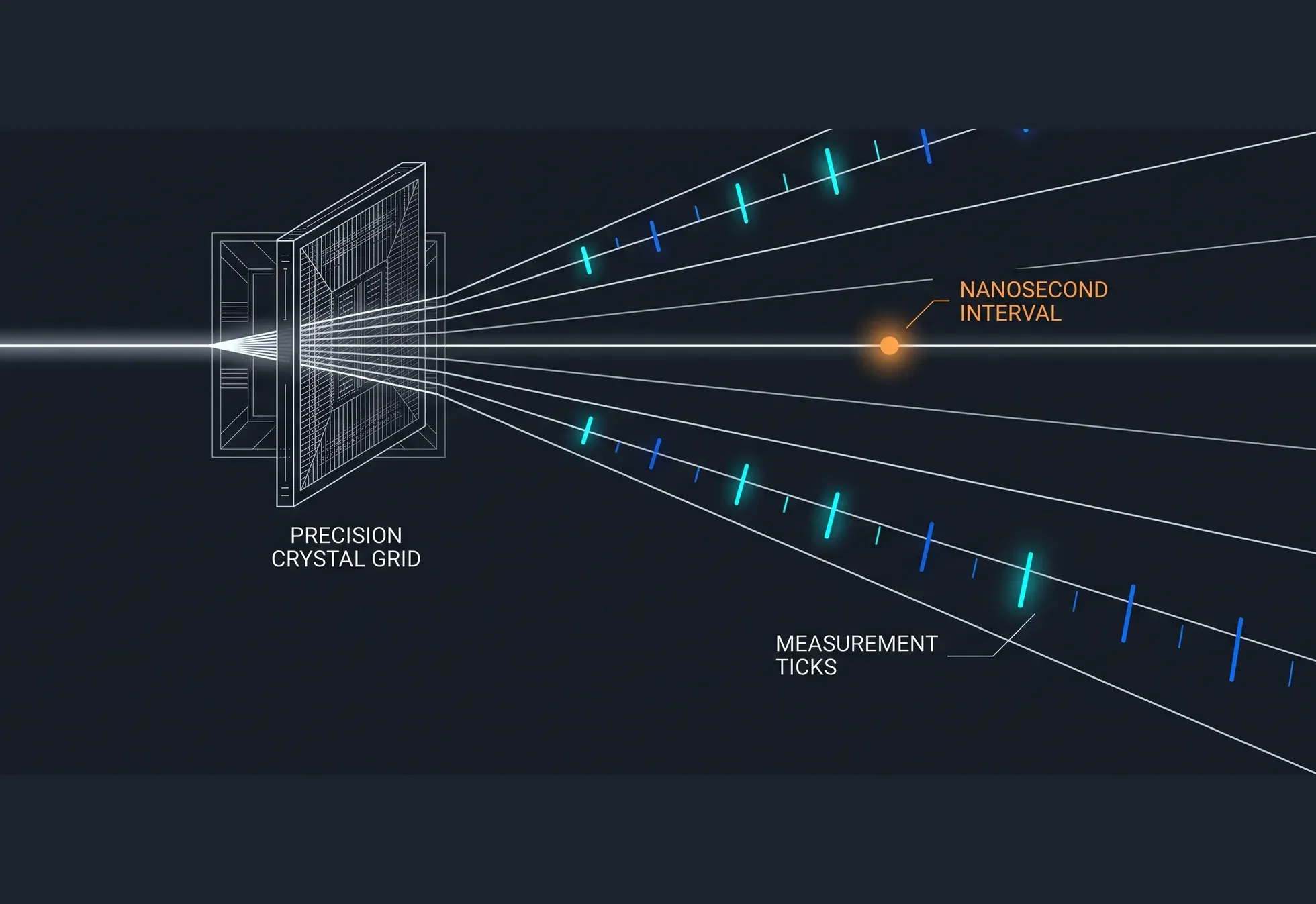
A Little Side Trip
How tall is tall?
A six-foot person is tall next to a child, and small next to a building. A mountain is enormous beside a house, and tiny beside a planet.
The number matters. But so does the reference.
I’ve been wondering whether time works the same way.
We understand a second because we live inside it. We can feel one pass. We can count one. We know roughly what ten seconds feels like. A minute makes sense because it belongs to ordinary human experience.
A millisecond is already more abstract. A microsecond — one millionth of a second — is harder still. And a nanosecond, one billionth of a second, is almost impossible to feel.
On paper, the definitions are simple:
- 1 millisecond = one thousandth of a second
- 1 microsecond = one millionth of a second
- 1 nanosecond = one billionth of a second
- 1 picosecond = one trillionth of a second
We can write those numbers down. We can calculate with them. But that doesn’t mean we can feel what they represent. For most of us, a nanosecond and a microsecond collapse into the same mental category: almost instantaneous.
That may be good enough for ordinary human life. I’ve been wondering whether it’s a good enough ruler for understanding machines.
So let’s change the ruler.
Imagine, purely as an analogy, that a single nanosecond is stretched until it lasts one human second. We’re not saying a computer experiences a nanosecond as a second — it doesn’t. We’re just stretching the scale until the human mind can take in the size of the intervals involved.
Under this imaginary clock:
- 1 nanosecond → 1 second
- 1 microsecond (a thousand nanoseconds) → about 16 minutes, 40 seconds
- 100 microseconds → about 1.16 days
- 1 millisecond (a million nanoseconds) → about 11.6 days
- 1 second (a billion nanoseconds) → about 31.7 years
Suddenly the scale feels different.
A microsecond no longer feels like nothing. It feels like waiting almost seventeen minutes. A hundred microseconds feels like more than a day. A millisecond feels like nearly twelve days. And a single second stretches across almost thirty-two years.
Again — none of this means a machine experiences time this way. The analogy has just one purpose: to expose the limits of human intuition.
When two events happen 100 microseconds apart, we might casually say they happened at nearly the same time. On our stretched clock, they would be separated by more than a day.
So if two sensors observe a changing system 100 microseconds apart, they did not observe the same moment.
Whether that matters depends on the task — and on how fast reality is changing.
If both sensors are looking at a stationary wall, perhaps 100 microseconds makes no difference at all. But if they are watching a moving hand, a vibrating surface, a spinning component, a collision, a fast-changing point of contact — the difference can matter enormously.
So the question isn’t really: are these measurements close together in human time?
The better question is: are they close enough in time for the physical relationship we are trying to understand?
That is a question of reference. A measurement doesn’t become meaningful just because we’ve attached a number to it. We also have to understand the scale on which that number matters.
It’s true for distance. It’s true for weight. It’s true for temperature. And it’s true for time.
I’ve been wondering if this is why machine-scale timing is so hard for us to feel: we instinctively use our own nervous system as the ruler. Anything far below the threshold of human perception feels, to us, simultaneous. But reality isn’t obligated to operate at the scale of human perception.
A billionth of a second is almost impossible to imagine. That doesn’t make it insignificant. It may simply mean our ruler is too coarse.
And I’ve been wondering…
Maybe, before we can understand a different scale of reality, the first thing we have to do is change the ruler.